From 'I Don't Know Where to Start' to First Place: How One Med Student Built Award-Winning Research
Success Stories

Jun 24, 2026
Share to :


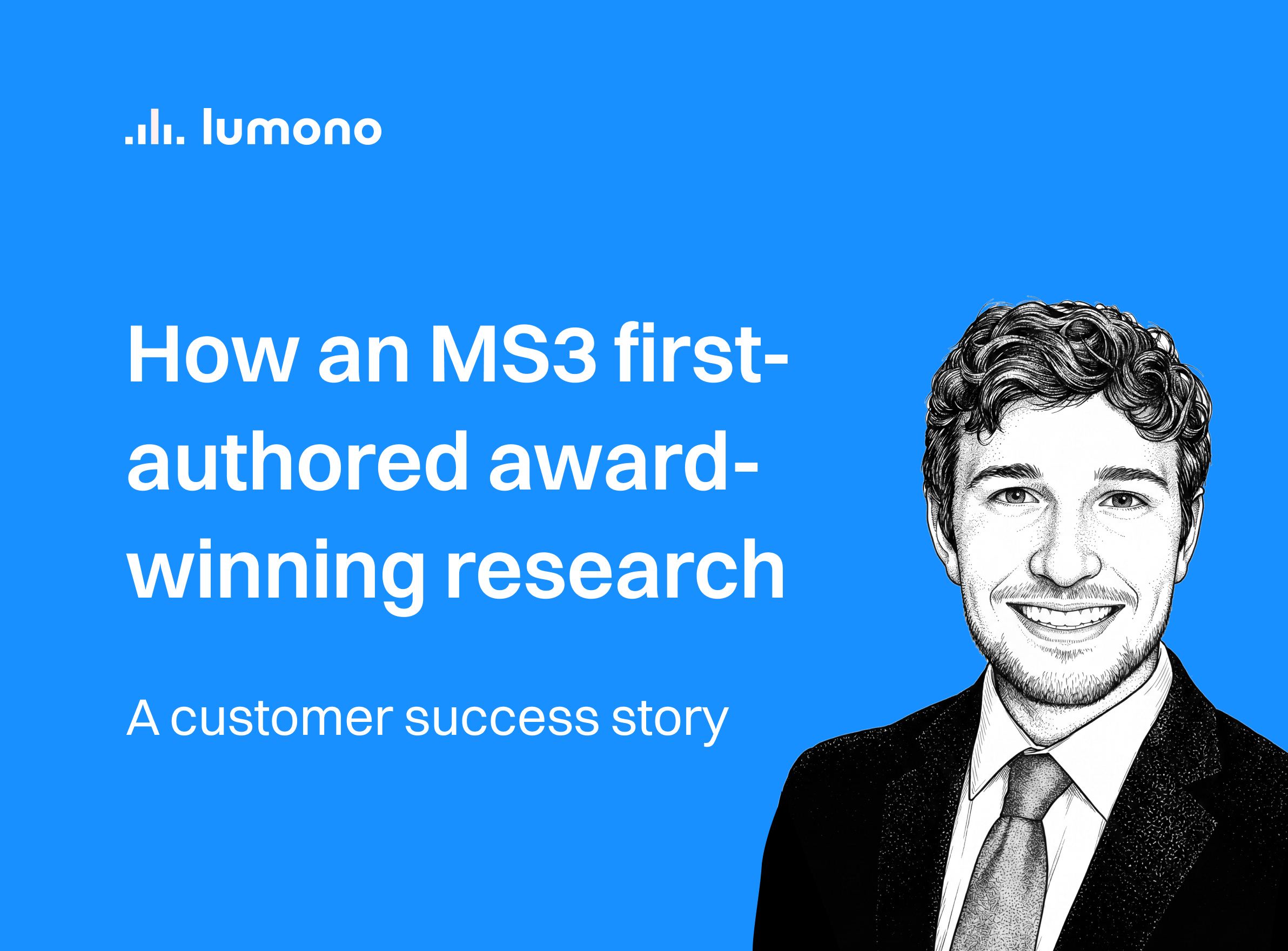
When Dylon Wetzel heard his name called for first place, he was in the far corner of a conference ballroom outside Orlando and had to walk the whole length of the room to reach the stage. He'd just presented his research on hypertension and physical activity to a room full of family physicians, plenty of whom had been practicing medicine since before he was born. His poster was one of more than a hundred submitted to the conference, and it had been pulled for the oral round.
A year before that, he had never made a research poster or presented anything. He'd never run a study of his own.
So how did he win first place?
He skipped patient recruitment and chart review entirely, analyzing existing NHANES data to produce an award-winning study on exercise and blood pressure.
Dylon realized he was lacking research partway through medical school, the way most of his classmates do. Some competitive specialties place a growing emphasis on research productivity. Without the work he ended up doing, he said, “I would have felt much more stressed about building a competitive research portfolio.”
His main obstacle with research was getting started. Early in training he went to a friend who'd published a lot of papers and was looking for advice in navigating the administrative barriers to entry: which rules to read, which IRB to submit to, what instances require patient consent. However, her answer stuck with him: "Someone doing research should already know these things," she told him. "That was just kind of discouraging."
That kind of gatekeeping pushes a lot of capable students out before they get going. His earlier attempts hadn't done much for him either. "Research can definitely be a slog when you're not genuinely interested in the topic," he said. The usual route — email a stack of faculty, wait to get added to someone's project, hope it leads somewhere — put him on everyone's schedule but his own.
He wanted to run a project on his own schedule, researching his own interests. That’s when he found a new way to approach research: a platform called Lumono, built for medical trainees.
Lumono is a platform for running database research: instead of recruiting patients or combing through charts, you analyze a large dataset that already exists. Dylon used Lumono to produce research from the NHANES database (the National Health and Nutrition Examination Survey) — a free, decades-long CDC program that has collected health, diet, and lab data on tens of thousands of Americans and is built to represent the country as a whole. (Here's a primer on what NHANES is and why it's useful for trainees.)
The data is what eats the time on a study like this. Defining your variables, cleaning everything, and getting it into shape to analyze can run weeks before you've answered a single question. Dylon had worked with NHANES once before for a med school assignment on software he remembers as outdated and archaic.
Lumono handed him cleaned, analyzable data and a set of headline findings instead of a blank screen. He doesn't undersell what that saved him: "If I had done this project completely on my own, I think 75% of the work would have been getting the data," he said. He compares the output to ingredients: "You need to bake it yourself, mix it together."
The platform won't write your project for you. It clears the data work that ends most projects before they start, and leaves the thinking and the writing to you. What it gave Dylon was a structure he could work from: "The data from Lumono is already well categorized and well organized," he said. "As a medical student still developing statistical skills, if I'd made these spreadsheets from scratch on my own, it would have gotten very confusing very quickly."
The result held up under scrutiny. Working from 6,123 adults weighted to represent 245.2 million Americans, Dylon looked at whether meeting the recommended 150 minutes of weekly aerobic activity tracked with lower blood pressure. Just over half the sample (54.7%) met that mark, and hypertension was less common among them: 34.4% versus 41.2%. Even after adjusting for age, sex, education, and other factors, meeting the guideline was tied to about 21% lower odds of hypertension. In his words, that's "meaningful when considering the potential public health implications”, and on a sample that size, it's the kind of project he hadn't expected to be leading as a medical student.
Writing it up was on him. He started with the methods section, which barely changes from study to study on a database project, kept the introduction short, and spent his time on the results. He used AI-assisted literature search tools to identify recent papers for his background and built his figures in Excel from the data Lumono had already organized. Before submitting, he ran a draft past a faculty mentor, one knowledgeable reader rather than a whole research team.
Once the data is clean, the writing goes quickly. "If I just wanted a good, acceptable abstract that was medically sound, made sense, and was presentable —you could submit it to a conference — you could probably produce a solid first draft in a day or two," he said. And because abstracts follow a rigid format, once he had one that worked, he could reshape it for even more future studies instead of completely starting over. (Here's a realistic timeline for an NHANES study from start to submission.)
Much like statistics, visual design is not something they teach you in medical school. Dylon admits his first poster came out rough. He'd never made one before, and so he wrestled with a PowerPoint template, and learned that the hard part of poster creation is getting enough on the board to be useful without turning it into a wall of text. By the second and third, he had a layout he trusted: title up top, chart in the middle, findings at the bottom, everything else down the sides, all to the point without being overwhelming.
He submitted to several conferences and got into three: the Florida Academy of Family Physicians, the Physicians Society of Central Florida, and the Florida ACP. At Florida ACP he presented his poster and was named a finalist.
The family physicians' conference was the big one. His poster was pulled from the field of a hundred-plus for an oral presentation. He turned it into a stripped-down slide deck, and presented it to the room after a practicing physician and a resident. When the awards came, they started at third and worked up. "It's a lot of imposter syndrome," he said. He remembered wondering: “How did I get here as a medical student? Was my work really good enough to be here?” And then the moment came when they called him for first place.
If your abstract gets accepted and you're suddenly staring at a format you've never prepared for, that's a skill set of its own. We wrote a three-part guide on it: the presentation types you might get assigned, how to prepare and deliver each one, and how to network once you're there.
Dylon is applying into radiology, where Step 2 carries weight and research helps. The projects gave him something he could actually defend. "Anything is fair game in a residency interview," he said. "If they're talking to you about a project and you have no idea what it was about because your friend just put your name on it — that's completely different. It was really cool to have that ownership."
Being first author, and the person who built the poster and wrote the abstract reads differently to an interviewer than a name added to someone else's work. The angle was his own, too. "Someone with the same data probably could have done a completely different project," he said. "Looked at it from a different aspect than the direction I went."
The recognition reached his school. At the family physicians' conference, the dean of his medical school, Florida State University College of Medicine, congratulated him in person and asked for a photo for the school magazine. He ended up featured among the students FSU was showing off that year.
He still sounds a little surprised by it. "I wouldn't have imagined seeing myself in this place way back at the end of last year," he said. "I wouldn't have thought I'd be one of the students who had actual, tangible research that others found valuable and worthy of recognition.”
Dylon didn't start with a research background. He started with a question and a dataset, and kept going from there.
Lumono is a research platform for medical students, residents, and faculty who want to run their own studies without chart review, months of waiting, or a statistician on call. You browse variables across trusted national health databases like NHANES, NHIS, and MEPS and save the ones that interest you. From there, Lumono suggests research questions that fit the data, helps you structure one into a population, exposure, and outcome, runs the statistical analysis, and generates manuscript-ready methods and results.
It won't do the thinking for you. You pick the question, read the results, and write them up. What it takes off your plate is the part that stops most people before they start: the weeks of data work between an idea and an answer, the same stretch Dylon got past on his way from a question to a first-place presentation.
You can try Lumono free and start your first project today. If you'd rather read more first, our newsletter sends practical research walkthroughs like this one every month.
Want more research tips? Sign up for monthly updates .
RELATED